Bridging the Semantic Web and Systems Engineering: OML in practice
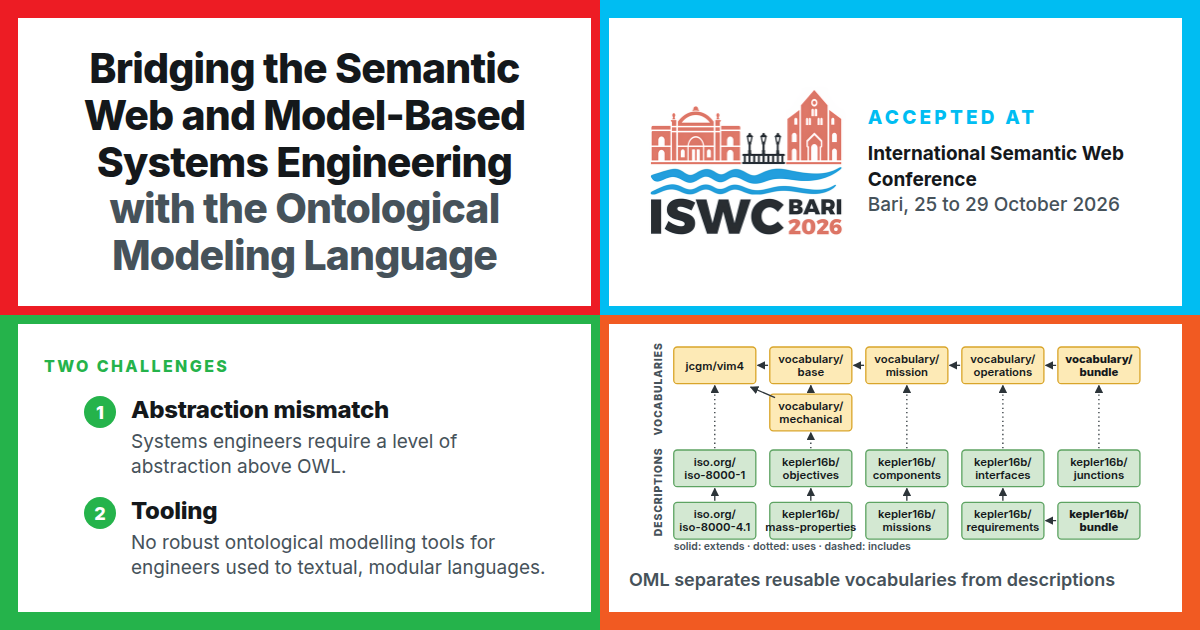
I’m happy to say that our paper ‘Bridging the Semantic Web and Model-Based Systems Engineering with the Ontological Modeling Language’ was accepted at the International Semantic Web Conference (ISWC 2026). The paper is by Maged Elaasar (Modelware), me, Eduard Kamburjan (IT University of Copenhagen and University of Oslo), Mohammad Hamdaqa (Polytechnique Montréal), and Abdelwahab Hamou-Lhadj (Concordia University).
As in the title, the paper is intended to bridge the semantic web (SW) and model-based systems engineering (MBSE) communities. While SW principles have been used in MBSE for some time, we still see challenges. The paper thus has three main points:
- identify these challenges. First, SE models lack semantics suitable for ontological reasoning. Languages such as OWL provide these semantics, but are not the proper level of abstraction for describing SE. Second, there is a lack of robust ontological modelling tools for engineers, and so no established methodology for using ontologies in SE.
- discuss how OML and the openCAESAR framework address these challenges
- report on how OML and openCAESAR are used in practice, with some discussion of reported benefits and drawbacks
We hope that this work is useful to the semantic web community in understanding the perspectives and requirements of the systems engineering community, as discussed below. We look forward to discussions about what needs to change on both sides such that the power of the semantic web can help in the development of complex systems.
An author pre-print is available here. Related work of ours includes openCAESAR: Balancing Agility and Rigor in Model-Based Systems Engineering on the toolchain, and a survey of practitioner experiences in model-based systems engineering. OML itself, with tutorials, is at opencaesar.io.
Abstract
The Ontological Modeling Language (OML) is an ontology description language that stems from applying the principles of ontological modeling in the systems engineering (SE) field. SE has specific requirements on tooling and methodology that have hampered the adoption of Semantic Web technologies in this field. In particular, we identify as challenges the lack of rigorous semantics for SE models, and the lack of a well-established methodology for effectively using ontologies in SE. We describe OML principles through an SE example and describe an OML methodology and tooling. We also describe the status of OML adoption and usage, including projects at NASA, JAXA, Leonardo, and academia. We aim to describe OML in practice, its principles, and its tooling for the semantic web community, such that best practices can be exchanged more easily between the two communities.
Two challenges for the semantic web in systems engineering
We claim that ‘the languages and frameworks currently used for ontology engineering are not suited to be integrated in MBSE workflows’. In the abstract, we identify two challenges: ‘the lack of rigorous semantics for SE models, and the lack of a well-established methodology for effectively using ontologies in SE’. In the paper, we look at why each piece is still missing:
- Abstraction mismatch. SE models lack rigorous semantics in the semantic web sense, so they cannot directly benefit from ontological reasoning. SysMLv2’s semantics are defined internally by its meta-model, so reasoning over a SysML model means first generating a knowledge graph from it. Ontological languages such as OWL do provide these semantics, but are not the proper level of abstraction for describing SE.
- Engineers wish to rely on well-known patterns (composition, aggregation), which OWL has no built-in relations for.
- They also wish to reason about their system in a closed-world form, with a clear interface to an open-world.
- Inadequate tooling. There is a lack of robust ontological modelling tools suited for experts used to textual and modular languages, and without them there is no well-established methodology for using ontologies in an engineering workflow.
- “Protégé requires significant experience in knowledge representation and semantics”.
- Tools work on OWL axioms in isolation, so connecting constraints, queries, and mappings to an ontology means maintaining those dependencies by hand.
- Other tooling requires alignment with upper ontologies, which can hamper the velocity of system development.
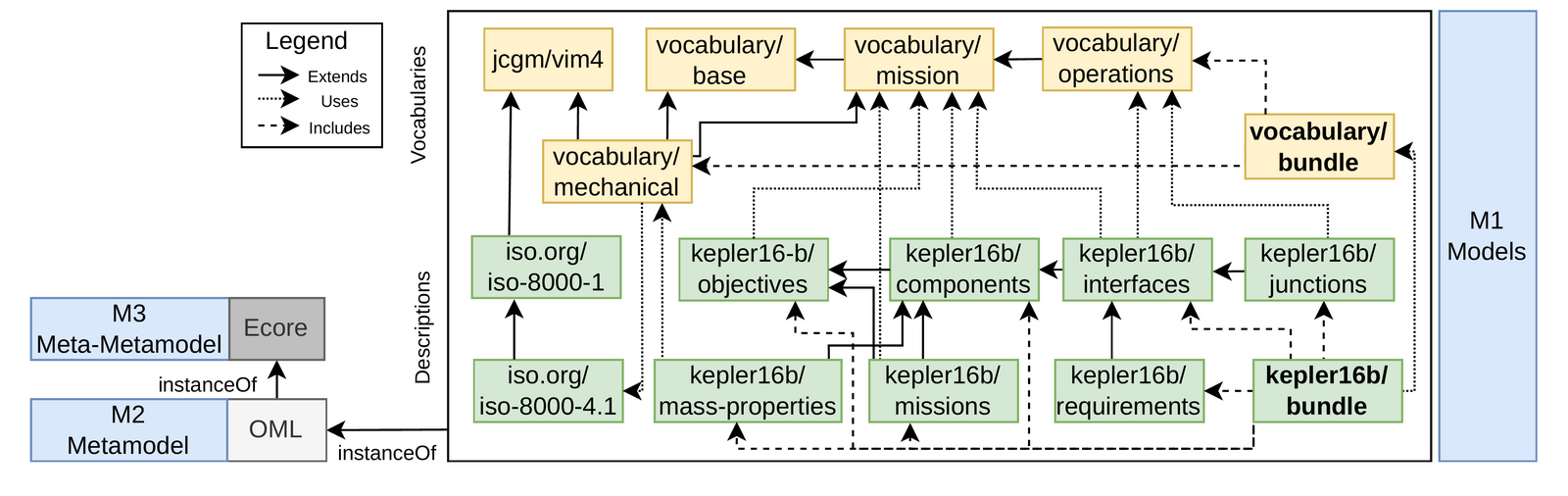
We thus argue in the paper that OML provides a suitable layer above OWL, such that engineers can have the benefits of the semantic web (interoperability, ontological reasoning) while still matching MBSE practice requirements (modularity, textual syntax), and that openCAESAR provides suitable tooling for practice (CI/CD, Maven versioning, textual editor).
OML in practice
We report on a few examples of OML and openCAESAR use in practice. For example, at JPL, an ontology was created in OML to provide consistency and semantic checks for spacecraft electrical wiring. This replaced an error-prone Excel spreadsheet. At JAXA, OML was used as a semantic backbone for spacecraft orbital analysis, shrinking the time required for analysis from weeks to hours. At Leonardo UK, OML vocabularies were used as the common ontology to bridge the data formats and semantics of separate avionics tools.
In academia, we mention the work by others on modelling validity frames, and our own work on using OML in the modelling of Digital Twins, such as DTInsight.